AI humans6 min read
The Indian AI stack explained: LLMs, voice, vision and the human interface (2026)

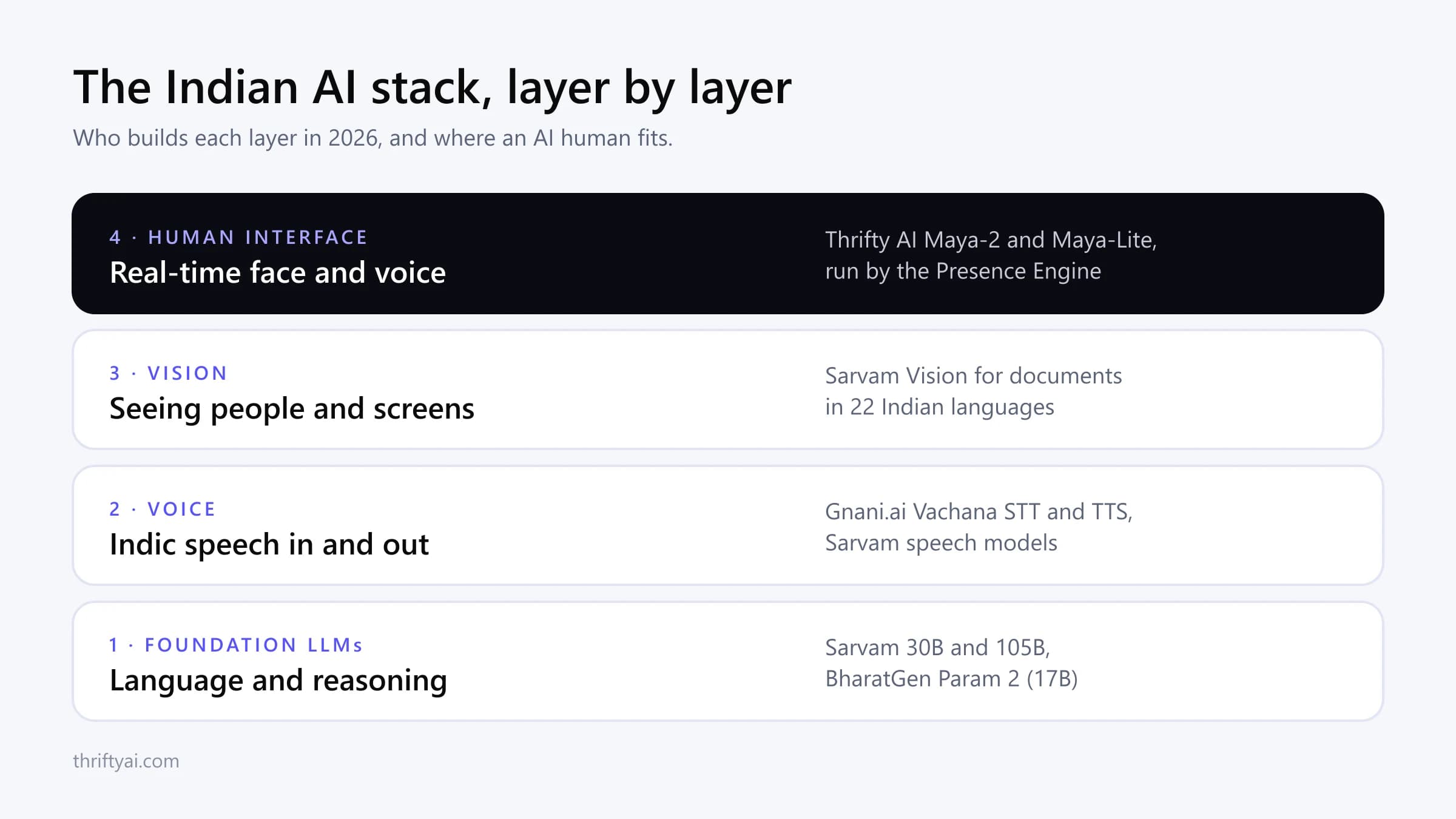
In 2026 a government team can, for the first time, build a citizen assistant from mostly Indian parts. An Indian model can reason, Indian speech models can listen and speak, and an Indian-built face can answer. This post maps who builds each layer and how the layers connect.
A note on our position: Thrifty AI does not build foundation language models. We build the human interface, the top layer. We credit the other layers to the teams that built them, with sources at the end.
What are the layers of the Indian AI stack?
| Layer | What it does | Indian examples (2026) |
|---|---|---|
| 1. Foundation LLMs | Understands the question and writes the answer | Sarvam 30B and 105B; BharatGen Param 2 |
| 2. Voice | Turns speech into text and text back into speech | Gnani.ai Vachana STT and TTS; Sarvam speech models |
| 3. Vision | Reads documents and sees what the user shows | Sarvam Vision |
| 4. Human interface | Gives the system a face and voice that talks in real time | Thrifty AI Maya-2 and Maya-Lite |
Layer 1: who builds India's foundation language models?
Sarvam AI announced Sarvam 30B and Sarvam 105B at the India AI Impact Summit on 18 February 2026. Both are mixture-of-experts models. Sarvam 30B has a 32,000-token context and Sarvam 105B a 128,000-token context. They were trained on IndiaAI Mission compute and released under the Apache 2.0 licence.
BharatGen, a government-backed consortium led by IIT Bombay, launched Param 2 at the same summit. It is a 17B-parameter mixture-of-experts model covering 22 Indian languages.
Both models can run inside a department's own infrastructure. That matters for the layers above them.
Layer 2: which models handle Indian-language speech?
Voice is where most citizen conversations happen, and where Indian languages are hardest. Accents, code-mixing and noisy counters all test speech models.
- Gnani.ai Vachana STT is a speech-to-text model released under the IndiaAI Mission. Gnani.ai says it was trained on over one million hours of real-world voice data.
- Gnani.ai Vachana TTS, launched in February 2026, speaks 12 Indic languages. Gnani.ai says it can clone a voice from under 10 seconds of audio.
- Sarvam AI also publishes speech-to-text and text-to-speech models for Indian languages.
Layer 3: what does vision add?
Citizens bring documents: forms, certificates, letters. Sarvam Vision, launched in February 2026, is a document-intelligence model that reads text across 22 Indian languages, per Sarvam.
An avatar needs vision for a second reason. It should see the person and the screen in front of it, so it can respond to what the user shows, not only what they say.
Layer 4: what is the human interface layer?
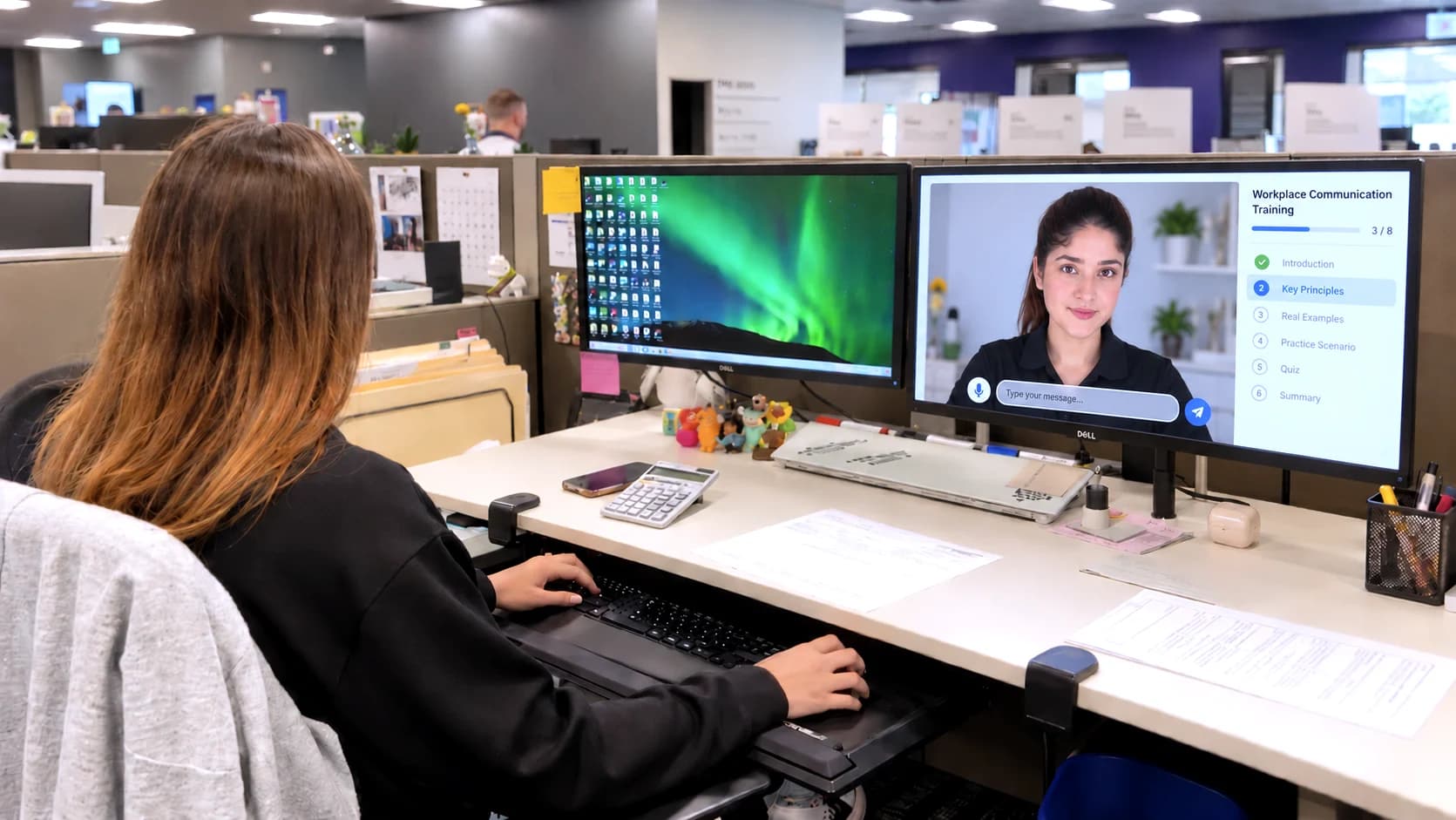
The first three layers produce text and audio. Many citizens, especially first-time digital users, are more comfortable talking to a face. The human interface layer adds that face, in real time.
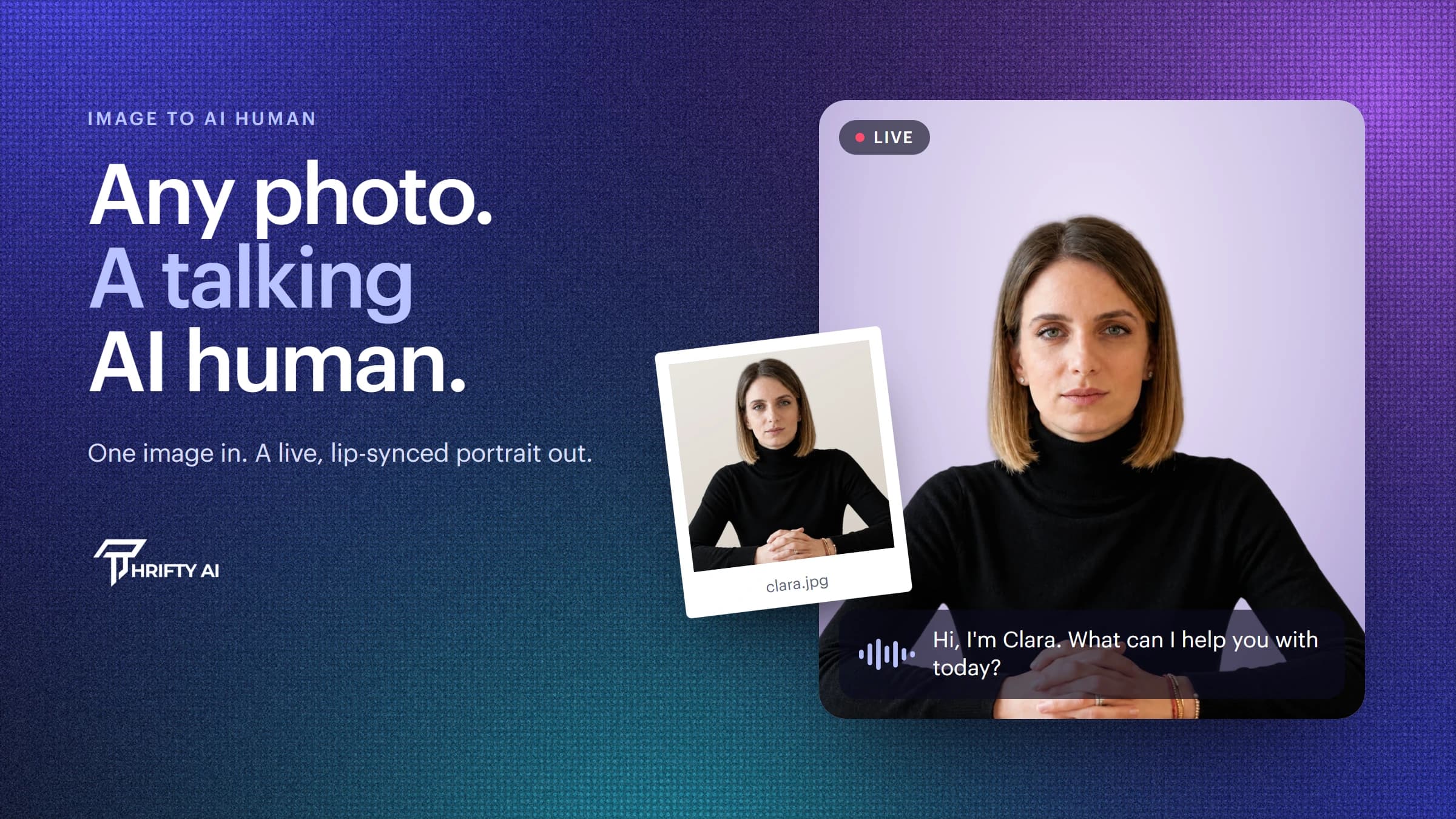
Thrifty AI builds this layer. Maya-2 is our full-body model: one image and a live voice become a lip-synced, gesturing video stream. It starts in 0.90 s, measured from first audio to first video frame, and streams at 32 FPS. Maya-Lite is a 1.2B-parameter talking-head model that runs on one consumer GPU, with no internet.
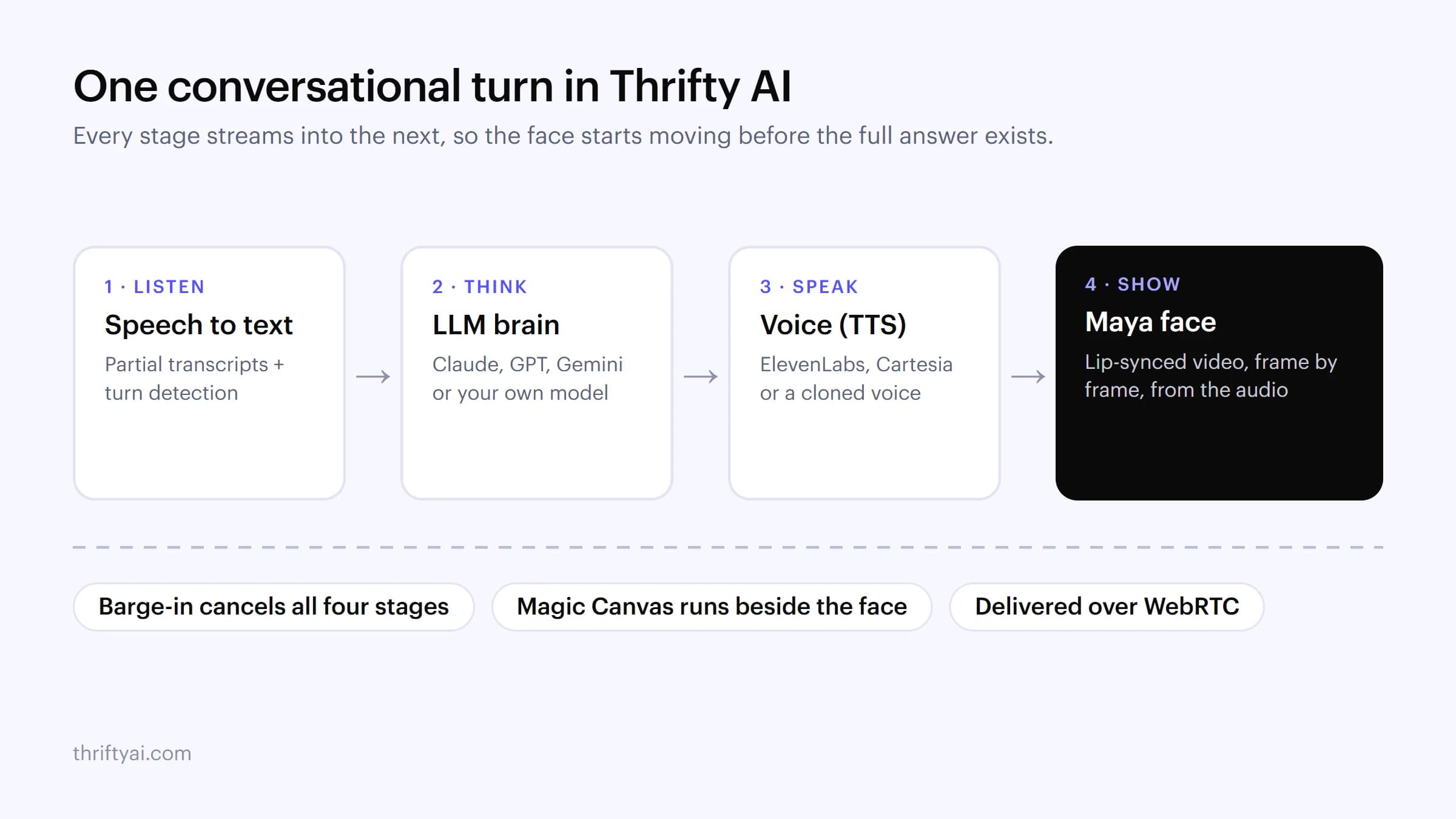
The Presence Engine chains the layers into one streaming loop. Its language model slot is open, so any of the models above can sit behind the face.
How do the layers fit together in a real deployment?
Take a citizen help desk at a district office.
- The citizen speaks Hindi to a kiosk.
- Vachana STT or a Sarvam speech model transcribes the question.
- An Indian LLM answers from the department's own documents.
- A text-to-speech model speaks the answer in the same language.
- Maya-Lite renders the face, lip-synced to that voice.
Every step can run inside the department's network or on the kiosk itself. Our post on on-prem AI avatars for government covers the three deployment patterns.
What is still imported?
GPUs, and much of the cloud capacity they run in. Sovereignty in 2026 is about data, model weights and deployment control, not silicon. Be precise about that when you write a requirement.
Frequently asked questions
Which layer of the Indian AI stack is Thrifty AI?
The human interface layer. Thrifty AI builds Maya-2 and Maya-Lite, real-time face models, and the Presence Engine that connects speech, the language model, the voice and the face. It does not build foundation language models.
Can a Thrifty AI avatar use Sarvam or BharatGen as its language model?
Yes. The language model slot is open, so an Indian model can run behind the avatar, in your own cloud account or on-prem.
Does the Indian AI stack work offline?
It can. Open-weight models can run on local hardware, and Maya-Lite renders the face on one consumer GPU with no internet. Check each model's licence and hardware needs.
Which Indian languages are covered?
Sarvam and BharatGen target 22 Indian languages, and Vachana TTS speaks 12, per their makers. Thrifty AI avatars converse in 70+ languages, including Hindi, Gujarati, Marathi, Bengali, Punjabi, Tamil, Telugu and Malayalam.
What is sovereign AI?
AI whose data, model weights and deployment stay under a country's or organisation's control. In India in 2026, that usually means Indian-built models running on infrastructure inside India.
Sources
- Sarvam 30B and 105B: Business Today, 18 Feb 2026 and Open Source For You, Mar 2026. Accessed 18 Oct 2026.
- BharatGen Param 2: Business Today, 16 Feb 2026. Accessed 18 Oct 2026.
- Gnani.ai Vachana STT: Gnani.ai. Vachana TTS: Business Today, 19 Feb 2026. Accessed 18 Oct 2026.
- Sarvam speech-to-text and text-to-speech models: Sarvam AI. Accessed 18 Oct 2026.
- Sarvam Vision: Sarvam AI and Business Today, 5 Feb 2026. Accessed 18 Oct 2026.
- Maya-2, Maya-Lite and the Presence Engine: thriftyai.com/research/maya-2, /research/maya-lite, /product/presence-engine.
Topics
- Sovereign AI
- Indian AI stack
- Indian languages
- Presence Engine
- Maya-2
- Maya-Lite
- Government