Industries6 min read
Why on-prem AI avatars matter for Indian government and PSUs

A citizen at a help desk says their Aadhaar number out loud. They describe a land dispute, a pension delay or a police complaint. If an AI avatar answers them, where does that audio go?
For most avatar products the answer is the vendor's cloud. For a government department or a public sector undertaking, that answer usually ends the conversation. This post explains why, and how to deploy an AI avatar that keeps every word inside your own network.
What is an on-prem AI avatar?
An on-prem AI avatar is a talking, listening digital human whose whole stack runs on infrastructure you control. That stack has five parts: speech recognition, the language model, the knowledge base, the voice and the rendered face. On-prem means all five run inside your network, not only the face.
Thrifty AI calls this loop the Presence Engine. It streams speech, the model's answer, the voice and the Maya face as one pipeline. The same pipeline runs in our cloud, in your cloud account or on a single device with no internet.
Why is the cloud default a problem for government?
Cloud avatar services send three things to the vendor: the user's voice, the transcript and the documents the avatar reads from. For a public help desk, each of these can hold personal or sensitive data.
- Voice: a recording of a citizen is personal data on its own.
- Transcript: it holds names, ID numbers, addresses and the details of a complaint.
- Knowledge base: internal circulars, case procedures and draft policy often are not public.
India's Digital Personal Data Protection Act, 2023 places duties on whoever processes personal data, including limits on transfer and retention. Department and PSU procurement rules often add their own hosting conditions. Read your own rules first. Then ask every vendor where each of the three items goes.
How can a department deploy an AI avatar without data leaving India?
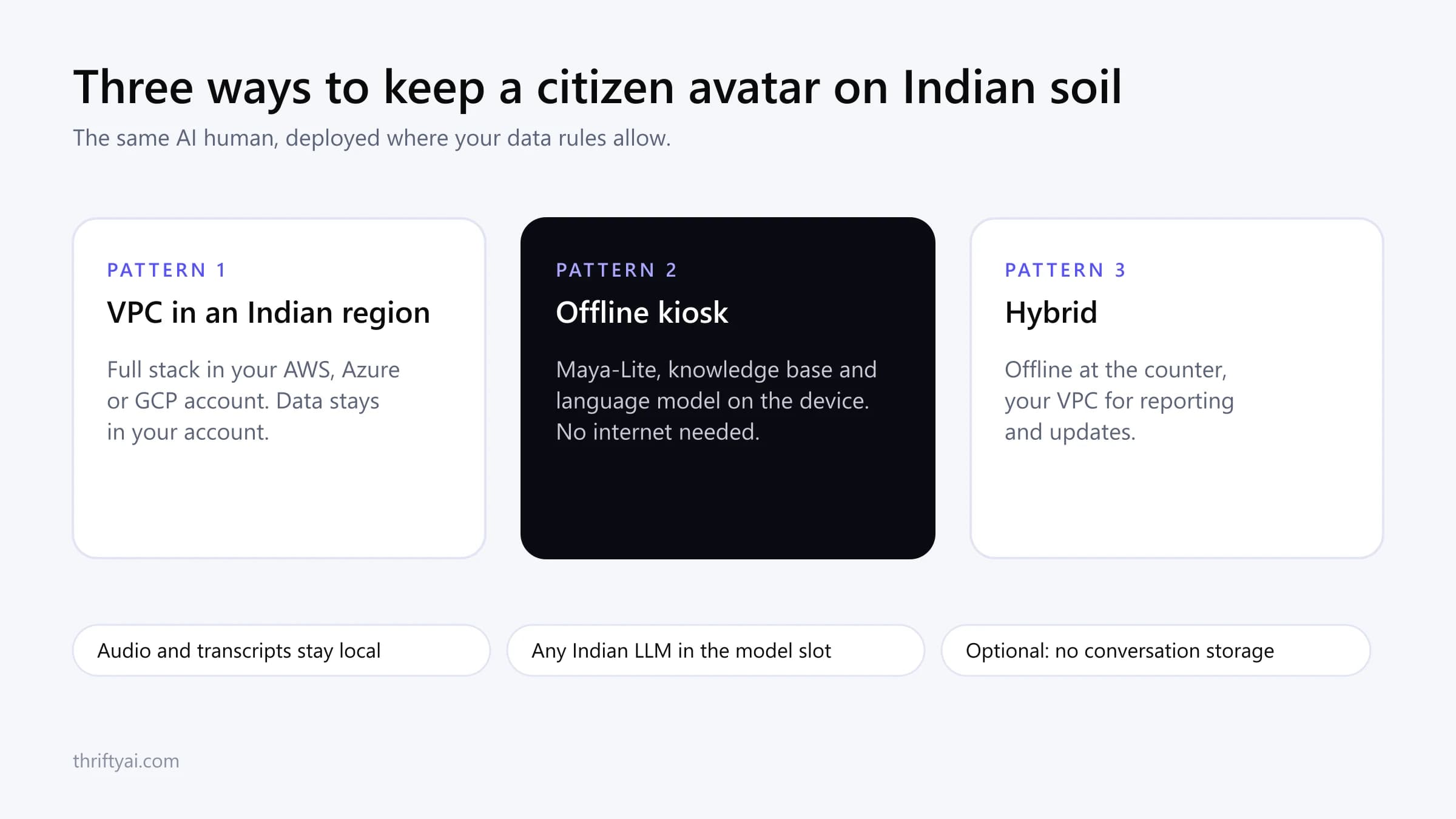
There are three patterns. Most departments start with one and add a second later.
1. Your own cloud account in an Indian region
The full Thrifty AI stack runs inside your AWS, Azure or GCP account, in the region you choose. Conversations, transcripts and documents stay in that account. This suits portals, video help desks and training platforms with many users at once. See self-hosting for the setup.
2. A fully offline kiosk
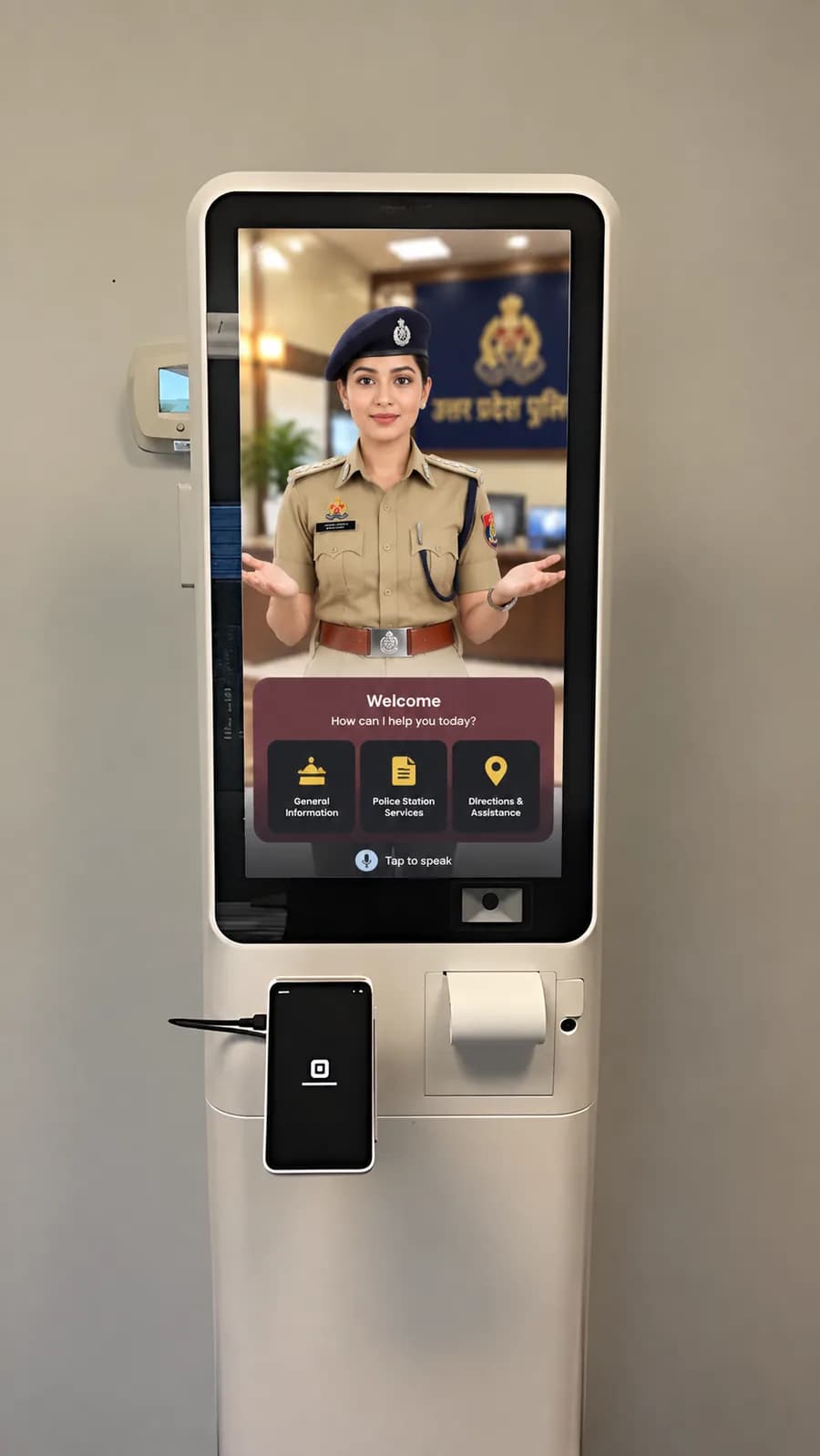
Maya-Lite is our compact face model, at 1.2B parameters. It runs on one consumer GPU, so the face, the voice, the language model and the knowledge base can all sit inside the kiosk. Pull the network cable and it still answers. This suits counters, police stations, hospitals and exhibition stands. See the AI kiosk.
3. Hybrid
The kiosk answers offline at the counter. When a connection is allowed, it syncs to your own cloud account for reporting and knowledge updates. Nothing goes to Thrifty AI's servers.
What stays inside your network?
| Data | Cloud avatar service | Thrifty AI in your VPC or offline |
|---|---|---|
| Citizen's voice | Sent to the vendor | Stays in your account or device |
| Transcript and logs | Stored by the vendor | Stored by you, or not stored |
| Knowledge base documents | Uploaded to the vendor | Stay on your servers |
| Language model | Vendor's choice | Your choice, including Indian models |
| Internet needed | Always | Not for the offline kiosk |
Which Indian languages can a government avatar speak?
Thrifty AI avatars converse in 70+ languages. These include Hindi, English, Gujarati, Marathi, Bengali, Punjabi, Tamil, Telugu and Malayalam. A citizen can switch language mid-conversation and the avatar follows. See AI avatars in India.
You can also choose the language model behind the avatar. That includes Indian models such as Sarvam's or BharatGen's, running inside your network. We explain the full Indian stack in our companion post.
Where is this running today?
Two public-sector AI ambassadors are shown on our site.
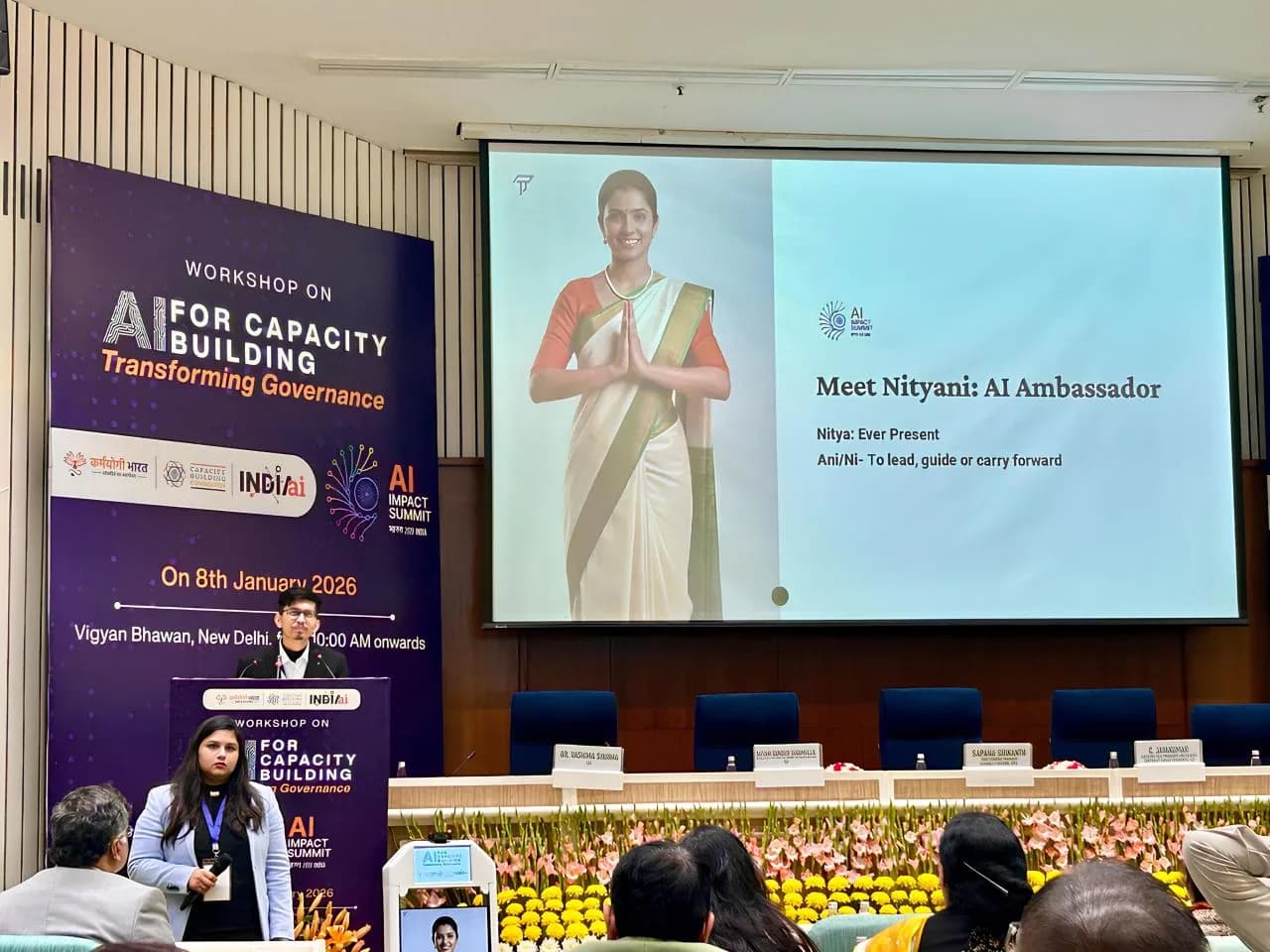
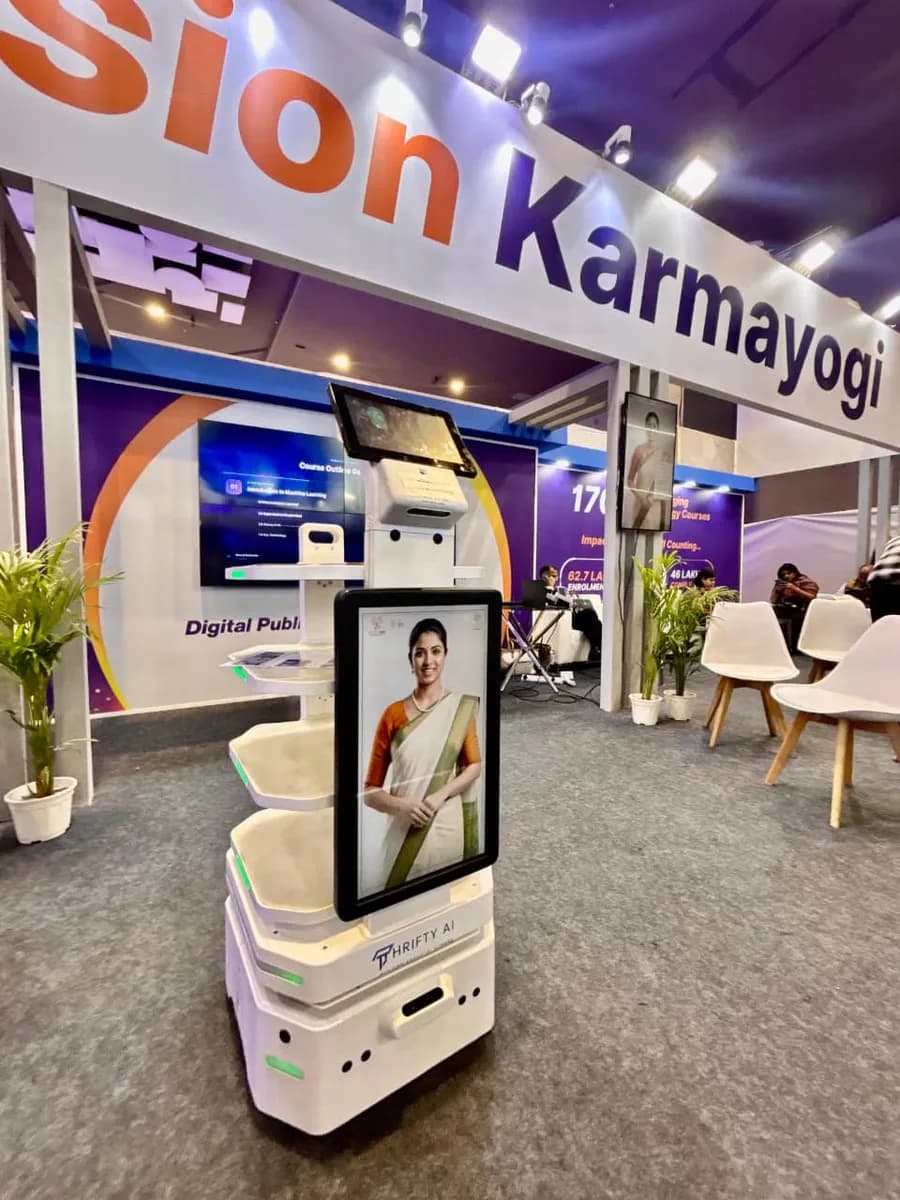
- Nityani, the AI ambassador for Mission Karmayogi. It was built with the Capacity Building Commission and Karmayogi Bharat to train public servants. It was presented at the AI for Capacity Building workshop at Vigyan Bhawan and shown at the India AI Impact Summit 2026.
- Urja, the AI ambassador for POWERGRID, presented on a HoloBox hologram display.
What should a department or PSU ask any avatar vendor?
- Where do the citizen's audio and transcript go, and who can access them?
- Can the full stack run in our own cloud account, in an Indian region?
- Does it still work with the network cable unplugged?
- Can we choose the language model, including an Indian one?
- Which Indian languages work end to end: speech in, answer, voice out?
- How is it licensed for self-hosting? Ours is an annual licence plus a per-minute rate.
- Who installs and supports it on site? Our AI FDE engineers work alongside your team.
Frequently asked questions
Can an AI avatar run without internet?
Yes. With Maya-Lite on one consumer GPU, the face, voice, language model and knowledge base all run on the kiosk or edge box. It answers with no internet connection.
Can a government AI avatar use an Indian language model?
Yes. The language model slot is the buyer's choice. It can be an Indian model such as Sarvam's or BharatGen's, running inside your own network.
Which Indian languages does Thrifty AI support?
Thrifty AI avatars converse in 70+ languages, including Hindi, English, Gujarati, Marathi, Bengali, Punjabi, Tamil, Telugu and Malayalam. Users can switch language mid-conversation.
How is self-hosted Thrifty AI priced for government?
Self-hosting is an annual platform licence plus a per-minute rate. Talk to sales for a quote based on your sites, languages and expected minutes.
Who maintains an on-prem deployment?
Thrifty AI's forward-deployed engineers (AI FDE) scope, build and run the deployment with your team, on site where needed.
Read next: the Indian AI stack explained, or see AI avatars for government.